How to Use a T-money Card in Korea: Subway, Bus & Refund Guide (2026)
Table of Contents
Once you've figured out how to order food in Korea, the next thing most visitors need to sort out is getting around. Seoul alone runs more than 20 subway lines and hundreds of bus routes, and buying a paper ticket for every single ride quickly becomes a hassle. The fix almost every local and long-term expat relies on is a small rechargeable card called T-money. This guide walks through how to buy one, how tapping on and off actually works, how the transfer discount saves you money, and how to get your leftover balance back before you fly home.
What Is T-money and Where to Buy It
T-money is Korea's prepaid transit card, accepted on subways, city buses, intercity buses, and most taxis across Seoul, Busan, Daegu, Incheon, Gwangju, and Jeju. The physical card itself is a one-time purchase, typically priced between 2,500 and 5,000 won depending on the design, and that fee is separate from the balance you load onto it.
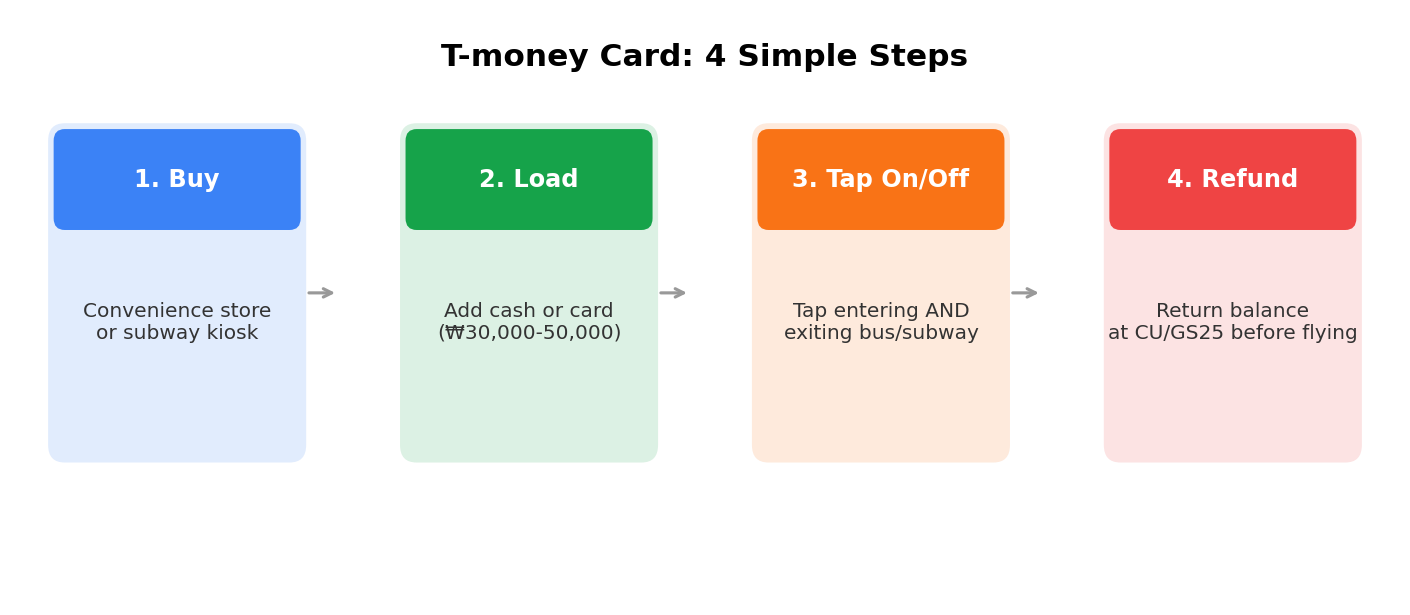
The easiest place to buy one is a convenience store — GS25, CU, 7-Eleven, and Emart24 all sell T-money cards at the counter, and staff at busy tourist-area locations are generally used to helping foreign visitors set one up. Ticket vending machines and service kiosks inside subway stations also sell and recharge the card, and it's available right at Incheon and Gimpo airports if you'd rather sort it out on arrival.
How to Use It on the Subway and Bus
On the subway, using T-money is straightforward: tap the card on the reader at the turnstile when entering, and tap again at the turnstile when exiting. The system calculates your fare automatically based on the distance traveled, so there's no need to work out pricing in advance.
Buses work a little differently. Tap the card near the driver when boarding, then tap it again on the reader near the exit door before you get off — in most Korean city buses, you board at the front and exit through a middle or rear door. Skipping the tap-off step doesn't just look careless; it also means the system can't calculate your correct fare or apply any transfer discount, and it may deduct extra on your next ride.
Transfer Discounts Explained
One of T-money's most useful features is the free or discounted transfer between subway and bus. If you tap off one ride and tap onto another subway or bus within about 30 minutes, you typically avoid paying a second base fare — you're only charged the difference for the added distance, if any.
This only works correctly if you tap out every single time, including on buses where it might feel unnecessary for a short ride. It's a small habit, but skipping it is the single most common reason tourists end up paying more than they expected over a multi-day trip.
| Action | What Happens |
|---|---|
| Tap on subway, tap off subway | Fare calculated by distance |
| Tap on bus, tap off bus | Fare calculated by distance |
| Tap off then tap on again within ~30 min | Transfer discount applied automatically |
| Forgetting to tap off (bus) | No transfer discount, possible extra charge next ride |
Common Mistakes and How to Get a Refund
Forgetting to tap off buses. This is by far the most common issue. Subway stations force you to tap out to physically exit through the turnstile, but buses don't — so it's easy to simply walk off without tapping, especially when you're tired or distracted.
Assuming every taxi accepts it. Many taxis in Korea do accept T-money, but not all of them. It's worth asking the driver before you rely on it as your only payment method.
Not checking the balance before a long trip. If you're unsure how much is left on the card, you can ask a convenience store cashier, or check the balance display that appears briefly on subway turnstile readers after tapping.
Forgetting to refund unused balance. Before heading home, small T-money balances can be refunded directly at convenience stores. For balances over 50,000 won, however, you'll need to visit Tmoney Town near Seoul Station (Exit 10) to process the refund in person — convenience stores can't handle larger amounts.
Once you've got a T-money card loaded and the tap-on, tap-off habit down, getting around Korea stops feeling like a logistics puzzle and starts feeling like second nature — which leaves a lot more energy for the things you actually came to see. And once you're out exploring, you'll probably want to eat — see our guide to ordering food in Korea for kiosks, phrases, and dining etiquette.
FAQ
Can tourists buy a T-money card?
Yes. T-money is sold openly to anyone at convenience stores nationwide (GS25, CU, 7-Eleven, etc.) and at Seoul subway station information centers on Lines 1–8, no ID or residency required.
Can I buy T-money with a foreign credit card?
The card itself and top-ups are typically handled with cash at convenience stores, though many store card terminals also accept foreign credit cards for the purchase. If a card payment is declined, cash is the reliable fallback — it's worth carrying some Korean won for this.
Do I need to tap off the bus in Korea?
Yes, always. Tapping off when you exit a bus is what allows the system to calculate your correct fare and apply any transfer discount. Skipping it can result in being charged extra on your next ride.
Can I get my T-money balance refunded?
Yes. Smaller balances can be refunded directly at convenience stores. For refunds over 50,000 won, you'll need to visit Tmoney Town near Seoul Station (Exit 10) in person, since convenience stores can't process larger refund amounts.
Korea Tourism Organization (VISITKOREA) — Transportation Cards Guide
Seoul Metropolitan Government — Transportation Guide
Fares, kiosk locations, and refund limits may change — always confirm current pricing at a station or convenience store.