How to Pay in Korea: Cash vs Card Guide for Tourists (2026)
Table of Contents
With T-money sorted and the subway figured out, the next practical question is simpler than it sounds: how do you actually pay for things? Korea is often described as a cashless society, and for the most part that's true — but foreign-issued cards don't always behave the way you'd expect, and a few categories of spending still lean heavily on cash. This guide breaks down where cards work smoothly, where you'll want won in your pocket, and how much to carry.
Where Cards Work Well
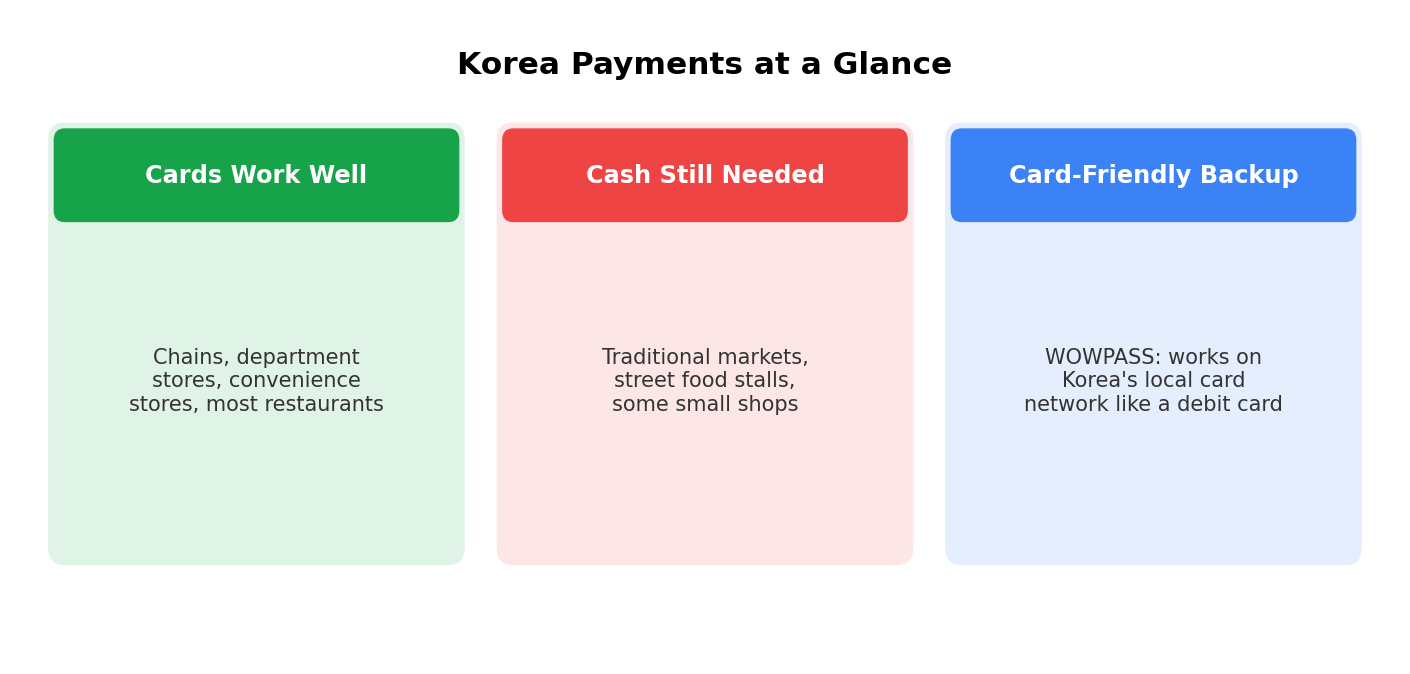
Major chains, department stores, convenience stores, and many restaurants accept international Visa and Mastercard. However, acceptance can vary by merchant and card issuer, so carrying a backup payment method is a good idea — this covers a large share of typical tourist spending, including accommodation, bigger meals, shopping at established retailers, and most cafes.
Mobile payment options are more limited for visitors than they might expect. Kakao Pay and Naver Pay, the payment apps most Koreans use daily, generally require a Korean phone number and bank account to use fully, which puts them out of reach for most short-term travelers. Apple Pay and Samsung Pay can work as a backup at some terminals, but acceptance is inconsistent enough that it's worth treating them as a convenience rather than something to rely on.
Where You Still Need Cash
Traditional markets are where the cashless reputation is most likely to catch visitors off guard. Places like Gwangjang Market or Namdaemun Market include many vendors who prefer or primarily use cash, even though card readers are increasingly common. Street food stalls and small, family-run restaurants — particularly outside central tourist districts — sometimes have card terminals that can't process international card networks, even when a card reader is visible on the counter.
Foreign-issued cards can occasionally be declined even at businesses that accept Korean cards. Acceptance may depend on the merchant's payment system, card network, or card issuer, so it isn't always predictable from the outside.
| Situation | Payment Notes |
|---|---|
| Department stores, chains, convenience stores | Cards generally work well |
| Traditional markets (Gwangjang, Namdaemun, etc.) | Cash is useful — payment options vary by vendor |
| Street food stalls, small local eateries | Cash is useful — card acceptance is inconsistent |
| T-money top-up at older kiosks | Often cash-only, though this is changing |
WOWPASS and Other Backup Options
For travelers who'd rather minimize how much cash they carry while still covering cash-only spots, WOWPASS is worth knowing about. According to WOWPASS's own guide, the card carries two separate balances that don't automatically share funds: a shopping balance, loaded by exchanging foreign currency at a kiosk and used for purchases at shops and restaurants, and a T-money transit balance, which must be topped up separately with Korean won and is used for subway, bus, and taxi fares. Exchanging cash at a kiosk fills the shopping balance only — it's a common mix-up for new users to assume that balance also covers transit, then get an "insufficient balance" error at a subway gate.
The shopping balance is generally accepted at restaurants, cafes, and shops across Korea, including some smaller businesses that turn away foreign-issued Visa or Mastercard. Kiosks for loading and exchanging currency are commonly found at Incheon Airport and major tourist areas.
For cash itself, ATMs marked "Global" or "International" — commonly found at convenience stores like CU, GS25, and 7-Eleven, as well as inside subway stations — accept most foreign cards, though a withdrawal fee typically applies. A practical setup for most short trips is one primary card for everyday spending, a T-money or WOWPASS card for transit, and a modest amount of cash set aside specifically for markets and street food.
None of this requires overplanning. Bring a card that works internationally, exchange or withdraw a reasonable amount of won for cash-only spots, and the gaps in Korea's cashless reputation stop being a problem and start being a minor detail you handle without thinking about it.
FAQ
Can I get by in Korea using only a card, no cash at all?
It's possible for much of a trip if you stick to chains, department stores, and card-friendly restaurants. That said, you may still encounter vendors that prefer or require cash, particularly at traditional markets and street-food stalls, so carrying a modest amount of cash as backup is the safer approach.
Why did my foreign card get declined at a small shop that accepts cards?
Foreign-issued cards can occasionally be declined even at businesses that accept Korean cards. Acceptance may depend on the merchant's payment system, card network, or card issuer, so it isn't always predictable in advance.
Can I use Apple Pay in Korea?
Apple Pay works at some terminals in Korea, but acceptance is inconsistent compared to inserting or tapping a physical card. It's worth treating it as an occasional convenience rather than a primary payment method during your trip.
How much cash should I carry in Korea?
Recommendations vary by trip style, but a common range for a short visit is roughly 50,000–100,000 won as backup, with more if you plan to spend heavily at traditional markets or rural areas with less card infrastructure.
Can I use Kakao Pay or Naver Pay as a tourist?
Generally not to their full extent. Both apps typically require a Korean phone number and bank account, which most short-term visitors won't have, so they're not a realistic primary payment method for tourists.
Korea Tourism Organization (VISITKOREA) — Transportation Cards Guide
WOWPASS — Official Usage Guide
Card acceptance, ATM fees, and app requirements can change — always confirm current details with your card issuer before traveling.